
Working within minutes
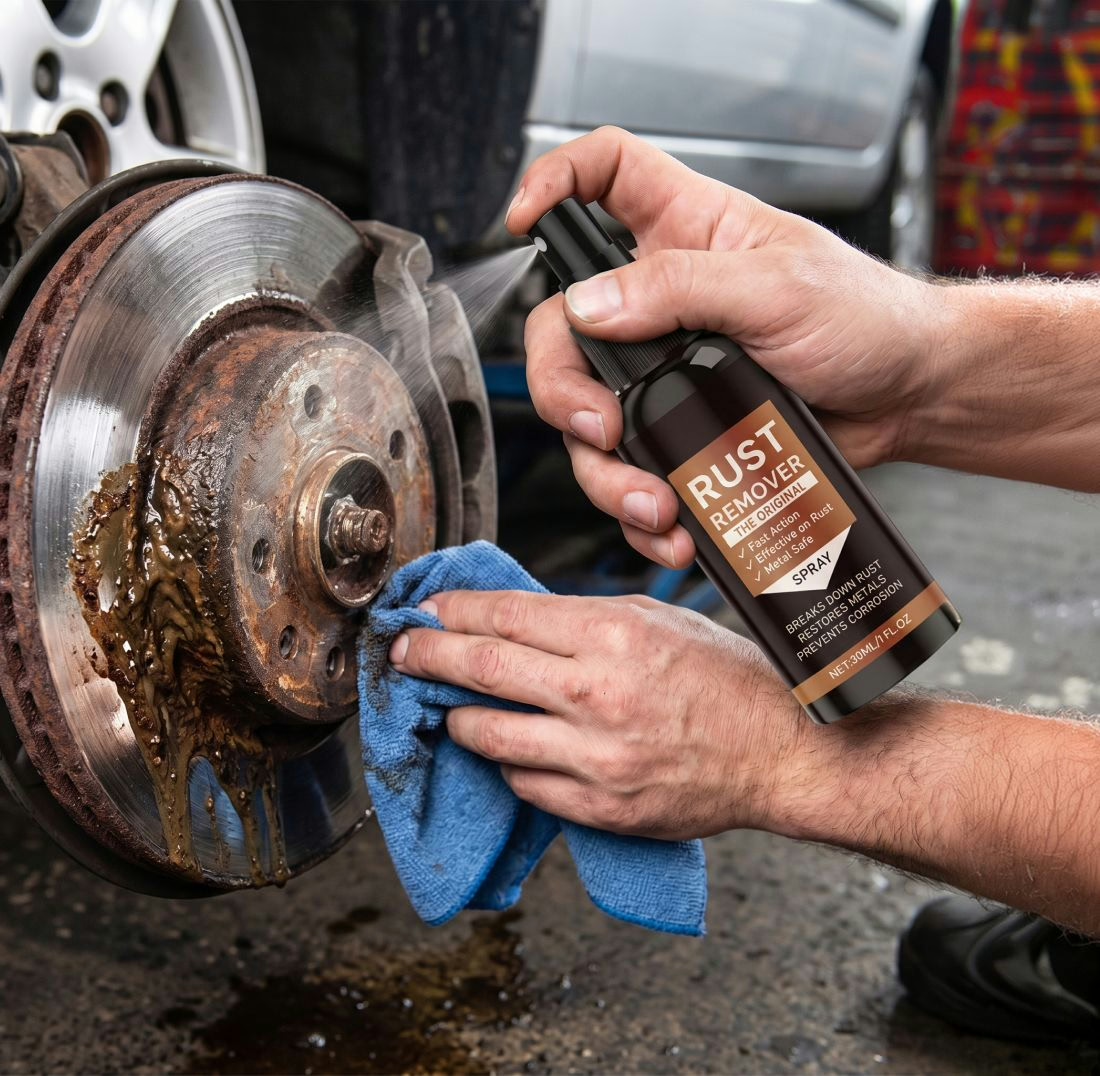
Spray it on, wait five to ten minutes, then wipe.
Say goodbye to rust in 10 minutes
A rust remover spray that does the work for you. Spray it on the affected part, leave it for five to ten minutes, then wipe with a cloth. No wire brush, no sandpaper, no soaking that takes all day.
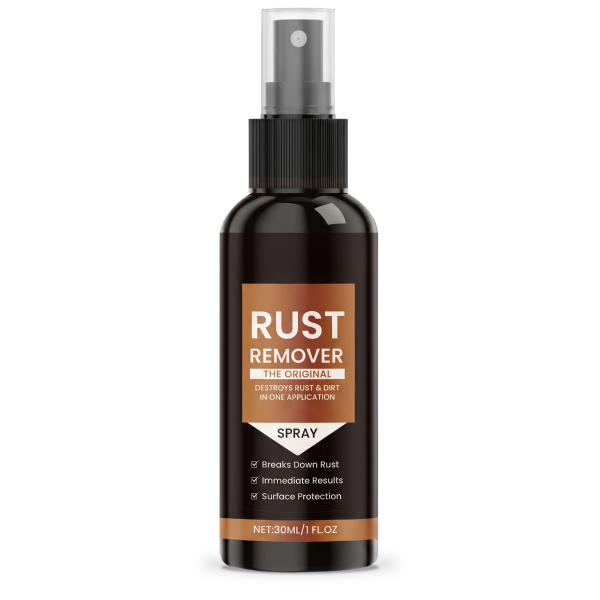
Working within minutes
Spray it on, wait five to ten minutes, then wipe.
No brush, no sanding
The product breaks the rust down, your cloth does the rest.
The metal stays intact
Nothing abrasive, so no material is taken off your parts.
30 days to decide
Try it on your own parts, refunded if it turns out useless.
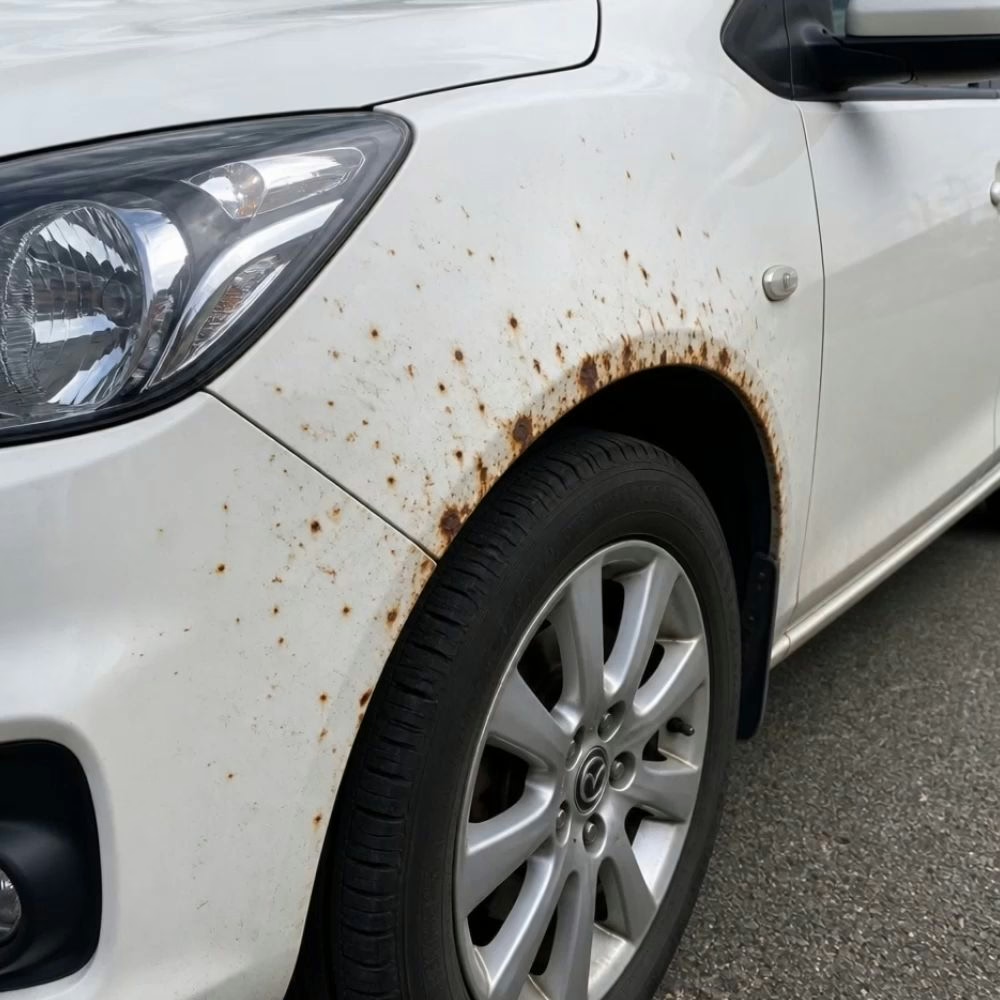
Rust gives no warning. It settles in over winter on the secateurs left outside, on the bike chain parked under the lean-to, on the spanner set at the bottom of the toolbox. Come spring, the verdict is always the same: the pliers no longer open cleanly, the bolt refuses to turn, the garden table leg leaves an orange mark on the patio. Nothing is broken, everything is simply seized and filthy. That is exactly the moment when a lot of perfectly good kit ends up at the tip.
The usual reflex is the wire brush. You scrub, you sweat, you spend half an hour on a single part. The surface often looks fine afterwards, but a brush and an abrasive pad make no distinction: they take off the rust and a little metal with it. Tools get thinner, parts get scratched, surfaces get weaker. On threads, hinge recesses or screw seats, the brush simply cannot get in. Soaking in vinegar is another option, but it is slow, it smells, and it ties up a tub for hours to deal with three nuts.
Rustifix changes the method rather than the effort. The product is sprayed straight onto the area, works into the pores of the metal and into the gaps a brush never touches, then breaks the rust down from the inside instead of tearing it off. After a few minutes of dwell time, the oxidised layer loses its grip. It comes away on a cloth, with a simple wipe. Your arm is no longer doing the work, the chemistry is.
There is a second effect, often as useful as the first. Once the part is cleaned and wiped, a thin film stays on the metal. That film helps limit direct contact between the surface and water or air, the two ingredients of corrosion. It does not make steel last forever, but it helps delay the return of rust spots on kit that lives outdoors or in a damp shed. In practice, you clean the same part less often.
First, the occasional DIYer, the one who opens the toolbox four times a year and finds seized spanners and an orange drill bit every single time. Then the homeowner, with a garage, a garden shed and patio furniture that spends the winter outdoors: gate hardware, barbecue castors, chair legs, watering can, metal table. Cyclists recognise the problem too, between the chain, the cassette, the pedals and the axles that pick up moisture as soon as a bike sleeps under a simple porch roof.
Then there are the people who inherit tools. You take over a father's or a grandfather's box, full of old pliers and good quality socket wrenches, but covered in thirty years of oxidation. That kit is often better than anything new, provided you can bring it back without filing it down. Finally, the product earns its keep indoors: scaled taps, sink surrounds, limescale on seals, a greasy hob, splashback tiles. Someone moving into a flat left in a sorry state usually needs a technical cleaner more than a drill.
It is worth saying what this product is not, because that matters just as much. It is not a paint or a coating: it covers nothing and hides no defect. It is not a permanent treatment: no product makes ordinary steel indifferent to moisture, and rust will come back sooner or later on an exposed part. It is not a structural repair either. If the metal is already perforated, if a sill panel has rusted through or if a load bearing bracket crumbles under your thumb, there is no material left to save and cleaning will change nothing. In that case the right answer is a new part, not a bottle.
Wire brush, abrasive paper, vinegar bath: every method has a cost, and the part is the one paying it.
The liquid does not just sit on the surface. It works down into the pores of the metal, into threads and gaps, then breaks the rust down from the inside. The layer loses its hold and comes away on its own. You tear nothing off, you wipe with a cloth.
Deep actionOnce the part is wiped, a light film remains on the metal. It helps limit contact with water and air, the two drivers of corrosion. That way it helps delay the return of rust. One pass cleans and leaves protection behind it.
Cleans and protectsA wire brush misses the part that matters. It does not enter a thread, does not go round a battery terminal, does not follow the links of a chain or the pin of a hinge. The sprayed product, on the other hand, gets in wherever it can run. And that is exactly where a part seizes up.
Threads and cornersRust is only part of the job. The same bottle takes on dirt, grease, engine grime, limescale, adhesive marks and sticky residue. It works on metal, tiles, ceramic, glass and hard surfaces in general. The workshop shelf empties instead of filling up.
One bottle, many jobsThe difference lies in the approach. A brush or an abrasive cloth works on the surface and by tearing: it removes whatever it touches, rust included, sound metal included. Rustifix works by contact and penetration. Sprayed onto the area, the liquid enters the pores of the oxidised layer and the gaps, threads, splines and joints between parts, places no tool can reach. It attacks the rust from inside the layer, which loses its cohesion and detaches on its own. The final move is no longer sanding, it is a simple wipe with a cloth.
The second stage is quieter. After wiping, the surface keeps a thin film. Its job is simple: it helps limit direct contact between the metal and water or air, so it helps delay the return of corrosion on a part that stays in a damp shed or outdoors. Think of it as breathing space, not a permanent barrier. That film wears off with handling, rain and friction, and it needs renewing at the next clean.
"Our aim comes down to two things: take off the rust and the grime without harming the part, then leave a film that helps delay the return of corrosion. This is maintenance, not a miracle, and that is exactly why it can be repeated without degrading the metal."
The Rustifix team
Let us be clear about the limits. Old, thick corrosion will not go in a single pass, so plan for a second application. Deeply pitted metal keeps its marks once cleaned, because the missing material does not come back: the surface becomes clean again, it does not become new again. The protective film slows the process down, it does not make steel stainless. And on kit that sleeps outdoors, maintenance still needs repeating now and then, once or twice a season depending on exposure. That is the price of metal living in the open air.
Ten minutes of dwell time, a cloth, and nothing else: no tools, no dismantling, no mixing to prepare.
Step 1
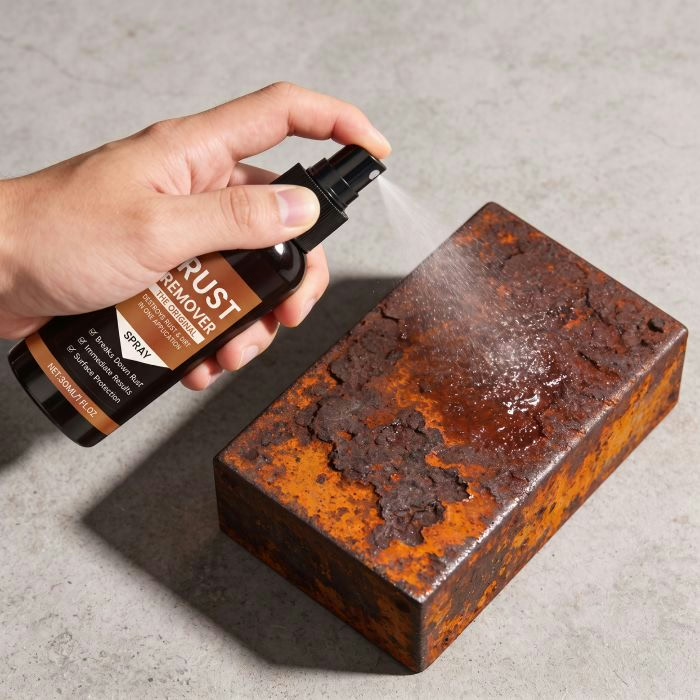
Point the trigger at the rusted part and spray until it is fully covered. Go over threads, screw heads and the corners where corrosion settles in.
Step 2
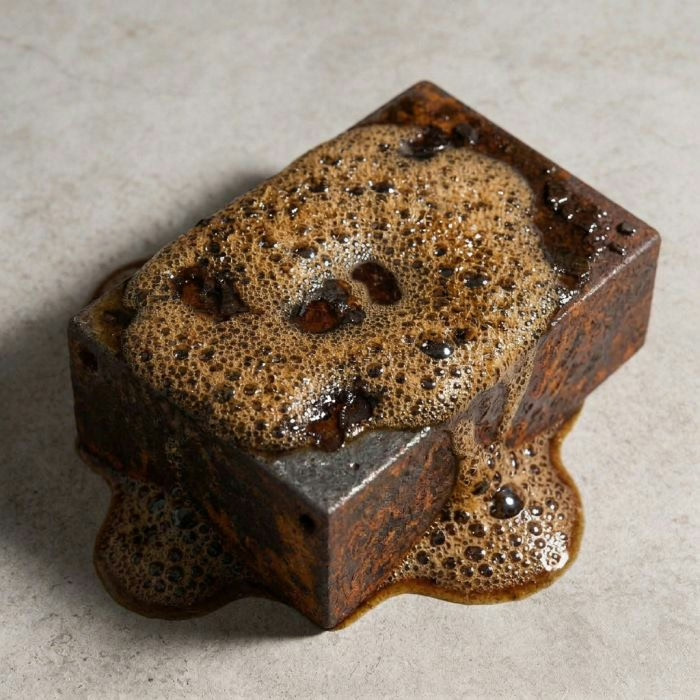
Allow 5 to 10 minutes for the product to soak in and break the rust down. You can get on with something else in the meantime, the part does not need you.
Step 3
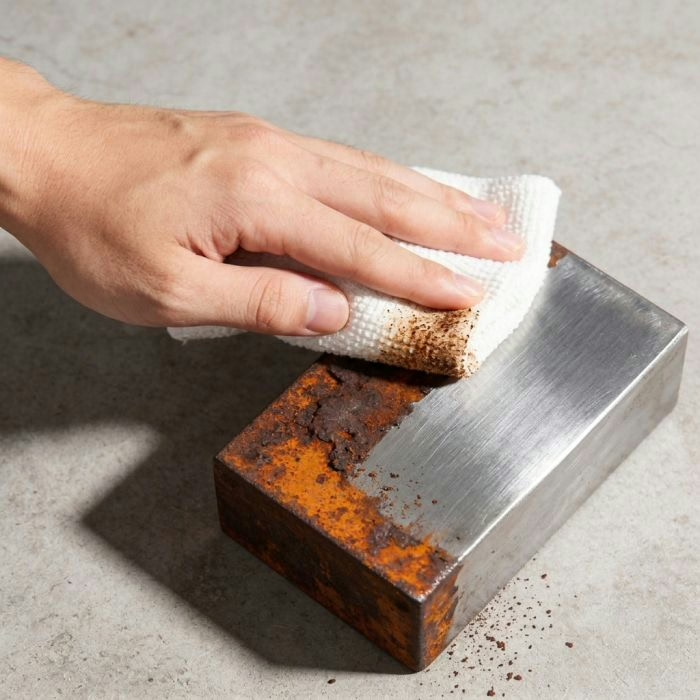
Run a dry cloth over it: the dissolved rust comes away with it and bare metal reappears. On a thick layer, do a second pass, keeping the total under 20 minutes.
The same criteria, applied to the classic methods and then to Rustifix, with no hedging.
| Criterion | Brush, abrasive, soaking | Rustifix |
|---|---|---|
| Removes visible rust | ||
| Works without scrubbing or sanding | ||
| Keeps the metal at full thickness | ||
| Reaches threads and corners | ||
| Leaves protection behind after the pass | ||
| Ready to use, no soaking or mixing | ||
| Also deals with limescale |
Three situations where the bottle leaves the shelf.
Tools forgotten in the garage
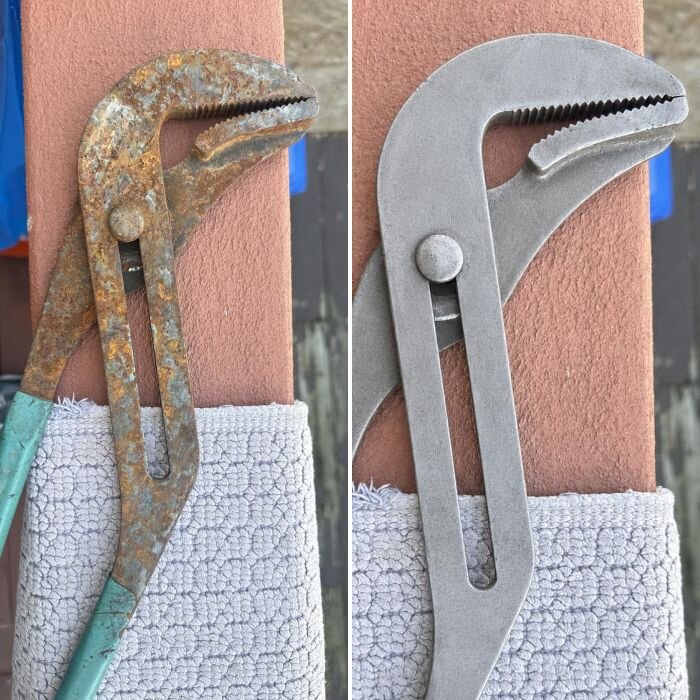
Spanners, pliers, drill bits, secateurs: one damp season is enough to pit them. Spray each item, lay them on a sheet of cardboard while it works, then wipe. Jaws and threads move freely again without ever seeing a brush.
The barbecue brought out after winter
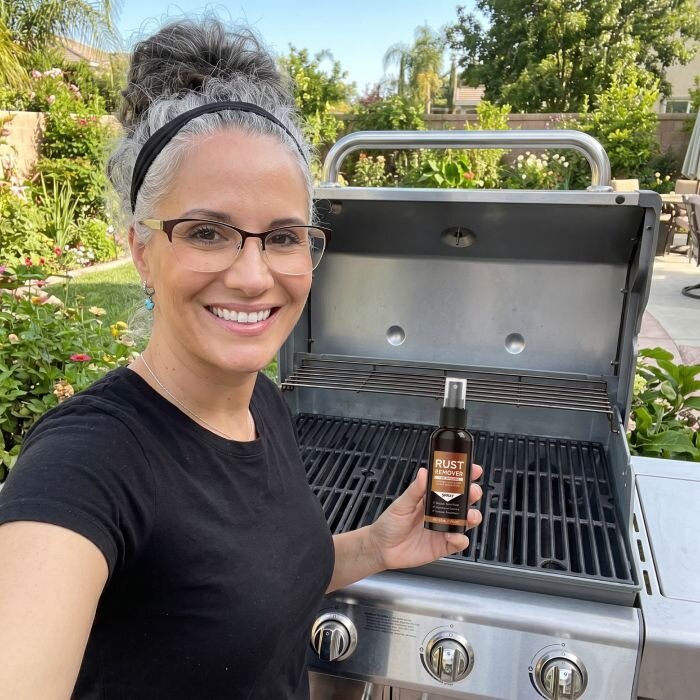
Greasy grill, pitted legs, garden furniture marked by the rain. The product deals with the rust and the grease in the same pass. One cloth, and the patio is ready before the guests arrive.
A seized bolt under the bonnet
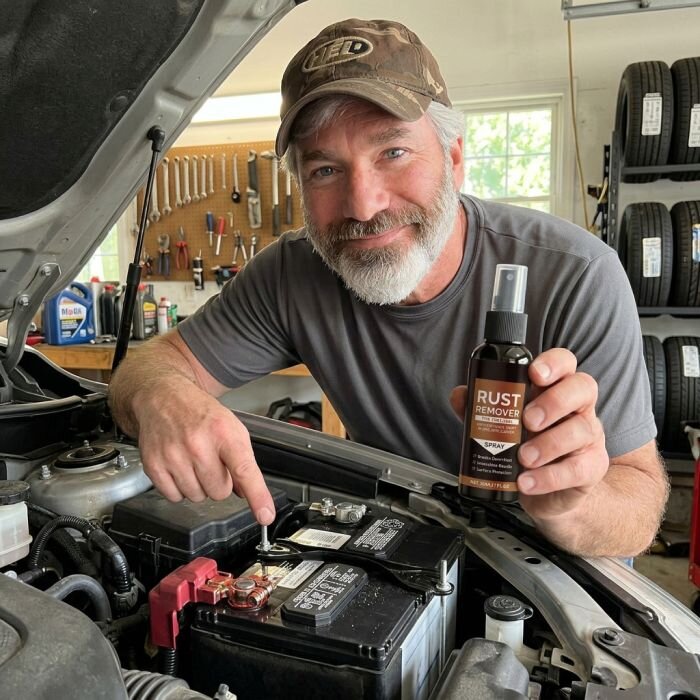
The bolt refuses to turn and the battery terminal has furred up. Spray it, then let it work while you fetch the spanner. The thread frees up and the connection is clean again, without forcing the tool.
The physical effort almost entirely disappears. Spraying takes ten seconds, the dwell time happens without you, wiping takes a minute. Where a seized pair of pliers used to mean twenty minutes of brushing and a sore wrist, all that is left is a cloth. Across a full toolbox, the difference adds up to hours.
The metal stays whole instead of being sanded away. That is the point people used to abrasives notice first. Secateur edges do not go round, screw heads keep their drive, chrome surfaces do not pick up micro scratches. A chemical action cannot tell the difference between pressing too hard and pressing just right, because there is no pressure at all.
The maths is straightforward. A spanner set, a patio suite or a good pair of secateurs cost far more than a bottle of maintenance spray. A seized car part you manage to free and clean is a replacement part you never had to order. And having small items blasted by a professional gets expensive fast for a job that cleaning is often enough to cover.
One bottle replaces several products. Rust on tools, grime on a mechanical part, baked grease on the barbecue grill, limescale on taps, adhesive marks on tiles or sticky residue on glass: these are very different kinds of dirt handled with the same trigger spray. It frees up room on the garage shelf and saves you working out which product goes on which surface.
Always start with a test on a discreet spot. That goes for any painted, lacquered, varnished or simply delicate surface. Pick the underside of a chair leg, the back of a hinge, a hidden corner of a panel. Spray sparingly, let it work, wipe, then look at the result in good light. If the appearance is unchanged, you can treat the rest without hesitating.
Clear the worst of it before you spray. A dry cloth over the dust, a sheet of kitchen roll on heavy runs of grease: the product needs to reach the rust, not get lost in a layer of dried soil. On garden furniture that has sat outside all winter, this simple step makes a clear difference to the first pass.
Cover the area properly and respect the dwell time. Spray generously, until the whole area is wet, then leave it for five to ten minutes. Two mistakes come up again and again: spraying too little, and letting the product dry before wiping. If the surface starts to dry, especially in full sun or in warm weather, give it a short extra spray before reaching for the cloth.
On thick or old rust, two short passes beat one endless soak. The first pass takes off the bulk, the second deals with whatever is still clinging in the pits and the threads. The whole job should stay under twenty minutes. Stretching the contact time indefinitely adds nothing and only increases the risk of the product drying on the part.
Worth noting: painted, chromed, lacquered or anodised surfaces deserve particular care. They behave differently from bare metal, and anodised aluminium does not react like the steel of a bolt. A test on a small hidden area takes two minutes and saves you an unpleasant surprise on a wheel, a bike frame or a worktop.
Work in a ventilated space, or better still, outside. A garage with the door open, a patio, a yard: the idea is to avoid standing in a closed room for long while spraying. Avoid contact with the eyes, never spray towards the face, and wash your hands after use. DIY gloves are a useful habit when you are treating several parts in a row.
Keep the bottle out of reach of children and pets, and away from everyday household products so it cannot be confused with them. Read the label before first use and follow the instructions printed on it: they take precedence and complete everything written here.
One last piece of common sense. Rustifix is a powerful technical cleaner, intended for the care of metal and hard surfaces. It is not a food product, not a cosmetic, not a personal care product, and it must not be used as one. Nor does it replace a mechanical repair: a cracked part, a stripped thread or a structure corroded right through needs replacing, not cleaning.
The average rating stands at 4.8 out of 5 across 1,864 reviews, and more than 9,500 orders have been shipped. What comes through most in the feedback is not raw performance but time saved: people who thought they would have to buy a new spanner set, replace a patio suite or give up on a seized bolt, and who got their kit back in an afternoon. Then comes the fact that the bottle does not stay a one off purchase. It ends up on the shed or garage shelf, and gets used again for the bike chain, the barbecue grill or the bathroom taps.
The feedback also mentions the limits, and we would rather own them than dodge them. Very old rust needs a second pass. Deeply pitted metal stays marked. The protective film delays corrosion without preventing it. A surface already perforated cannot be repaired. A maintenance product that is honest about its limits is worth more than a promise that falls apart on the first difficult part.
On the ordering side, the 30 day money back guarantee gives you time to test on your own parts, the ones that genuinely annoy you, before making up your mind. Shipping is tracked, so you can see where the parcel is without chasing anyone. The rest is judged on the first pair of pliers you free up.
The price per bottle drops from the second one onwards, which comes in handy when there is kit to sort out in the garage, in the cellar and outside.
1 bottle
-40 %
Was €44.90
29,90 €
per bottle
Total: €26.90
Order now2 bottles
-50 %
Was €89.80
24,95 €
per bottle
Total: €44.90
Order now3 bottles
-57 %
Was €134.70
21,60 €
per bottle
Total: €59.70
Order now4 bottles
-63 %
Was €179.60
18,70 €
per bottle
Total: €67.60
Order nowPrices shown in euros, all taxes included. Shipping costs are calculated at checkout.
Rustifix has 1,864 reviews for an average rating of 4.8 out of 5, here are a few of the comments received over recent weeks.

Declan M.
The battery terminals on my old estate car were caked in white deposit and the clamp screws were rusted solid. I sprayed everything, left it while I put my tools away, then wiped it with a cloth. Both seized bolts on the bracket came loose without me hauling on the spanner like an idiot.Verified order

Karen T.
My secateurs and shears had spent the whole winter on the bench at the bottom of the garden, under a tarp that let the rain in. I sprayed the blades and the pivots, left it ten minutes, then rubbed them with an old tea towel. The handles open properly again and the blades have gone back to grey.Verified order

Bas V.
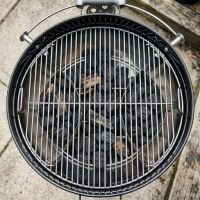
First barbecue of the spring, orange grill and patio table legs pitted all over. I did the grill first, wiped it with a cloth and the baked on muck came off along with the rust. The table legs took a bit more elbow grease, but you can see the result in the photo.

Freya N.
I had a ring of rust around the base of the bathroom tap, left there by a shaving foam can. I tested a small hidden spot first before doing the whole base, to be careful with the chrome. It took a second pass to shift the mark completely, so four stars, but it is clean now and I did not scratch anything.Verified order

Eoin C.
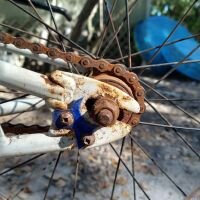
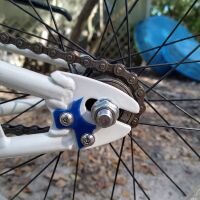
Two weeks of rain with my bike left outside, ginger chain and a rear mech that snagged on every gear change. I sprayed the chain and the derailleur cage, let it sit, then wiped it link by link with a rag. The photos speak for themselves, and the gears change again without that gravel noise.

Helen W.
I inherited my grandfather's toolbox, pitted open ended spanners and orange drill bits at the back of the drawer. I laid it all out on cardboard in the garage with the door open, sprayed, waited, then went over each piece with a cloth. The size markings are readable again, which I honestly had given up on.Verified order
The questions that come up most often before a first use, gathered here with no hedging.
How long does Rustifix take to work?
Allow 5 to 10 minutes of dwell time after spraying. During that time, the product works into the pores and gaps of the metal and breaks the rust down from the inside, before you wipe it off with a cloth.
On thick rust, a second pass is recommended, keeping the total under 20 minutes.
Do you still have to scrub or sand?
Avoiding sanding and the wire brush is precisely the point. Rust attacked by the product softens and comes away on a cloth, without any real mechanical effort.
On heavily loaded areas, one extra light pass with the cloth is usually enough to finish the job.
Does Rustifix damage metal and finishes?
Rustifix targets the corrosion layer and ingrained dirt, not the abrasive action that scratches. It can be used on metal, tiles, ceramic, glass and hard surfaces in general.
On a painted, lacquered or delicate surface, always test first on a small, barely visible area before treating the whole thing.
Does the rust come back afterwards?
After wiping, Rustifix leaves a thin film on the treated surface. That film helps limit contact with water and air, the two factors that restart corrosion, and so helps delay its return.
On kit that stays outdoors permanently, plan on a maintenance pass now and then rather than a one off treatment.
Is Rustifix only for rust?
No, it is also a multi purpose cleaner. It is designed to deal with dirt, grease, engine grime, limescale, adhesive marks and sticky residue.
Which is why it turns up in the bathroom as much as in the garage, on taps, pipes or garden furniture.
What precautions should I take at home?
Work in a ventilated space, with a door or window open. Avoid contact with the eyes and wash your hands after use.
Also follow the instructions on the bottle label, and keep the habit of testing first on sensitive surfaces.
What if I am not happy with the result?
Every order comes with a 30 day money back guarantee. Shipping is tracked, so you can follow your parcel right up to delivery.
More than 9,500 orders have already been shipped, for an average rating of 4.8 out of 5 across 1,864 reviews.
Rustifix brings workshop logic down to three moves: spray, leave it 5 to 10 minutes, wipe with a cloth. Where a wire brush attacks the metal, the product deals with the rust layer and hands you back a clean surface with no sanding. The thin film left after wiping helps limit contact with water and air, which helps delay the return of corrosion on exposed kit. The same trigger then goes to work on grease, engine grime, limescale or sticky residue, from a seized bolt under the bonnet to the barbecue grill. And if the result does not convince you, the 30 day money back guarantee still applies.
Current discount: up to -62% on multi packs
Order Rustifix